



- Details
- Parent Category: Currently
Queen of Tango
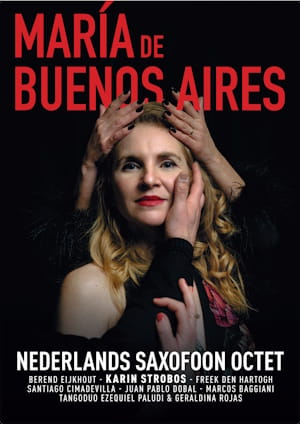
To the melancholic sounds of Astor Piazzolla's Adiós Nonino, a tear once rolled down Máxima's cheek. All of the Netherlands felt the soul of the tango at that moment. Twenty-five years later, Piazzolla's enchanting tango opera María de Buenos Aires returns to the Dutch stage, relevant as ever, in a brand-new production. The Netherlands Saxophone Octet was the first Dutch ensemble to receive permission from Piazzolla's heirs to rearrange this iconic work. The result: a thrilling cast of singers, actors, tango dancers, eight saxophones, bandoneon, piano, and percussion.
Maria de Buenos Aires tells the poignant story of the rise and fall of Maria, queen of the tango. The Duende, her creator, poetically brings her back to life as a resistance against a world in which only pleasure, power, and money seem to hold sway. Through Maria, this tango poet attempts to touch the soul of everyone. But where he sees inspiration, others sense mainly self-interest. When all boundaries are crossed, and Maria threatens to be destroyed by her passion, the Duende firmly draws a line.
Alongside the eight saxophonists—also tango dancers—mezzo-soprano and crowd-favorite Karin Strobos shines as the combative Maria de Buenos Aires, baritone and opera hero Berend Eijkhout as her vigilant male counterpart, and Freek den Hartogh as the idealistic Duende. And what would an inspired tango opera be without the bandoneon and dance? Maria de Buenos Aires therefore features the Argentinian musicians Santiago Cimadevilla (bandoneon), Juan Pablo Dobal (piano), and Marcos Baggioni (percussion), both of whom have had success in the Netherlands. The tango duo Ezequiel Paludi & Geraldine Rojas also impresses with their equally passionate and graceful dancing.
María de Buenos Aires is an eternal cyclical narrative of love and hate, passion and pain, life and death — an ode to the soul of the tango, to a life full of passion.
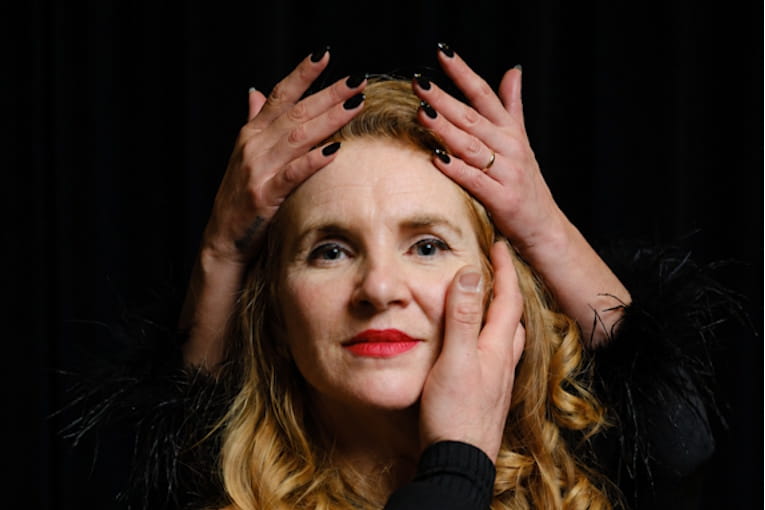
Foto © Teemu Kekkonen
Credits Cast & Crew
- Details
- Parent Category: Currently
Prepublicity
Orpheus Magazine, Ruud Buurman, July 01, 2026
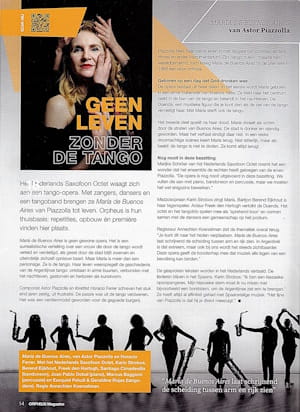
No life without Tango
Maria de Buenos Aires is no ordinary opera. It is a surreal narrative about a woman who is seduced and destroyed by the tango, continues to wander the city as a ghost, and ultimately gives birth to herself anew. But Maria is more than a character. She is the tango. Her life reflects the history of the tango: originating in poor neighborhoods, connected to nightlife, died and reborn as an art form.
Composer Astor Piazzolla and librettist Horace Ferrer wrote the piece out of frustration in the late 1960s. Passion had vanished from the tango. It had become a business model for the affluent bourgeoisie. Piazzolla breathed new life into it with longer compositions, different rhythms, and different instrumentation. His 'tango nuevo' made him world-famous, yet Maria de Buenos Aires received a lukewarm reception at its premiere in 1968.
You can transfer the entire theme of this piece to the present day. For Maria de Buenos Aires poignantly depicts the divide between rich and poor. This divide is extreme in Argentina, but it is starting to become so here as well. This opera conveys the message that music can unite all layers of a population.